Disconnected systems
Customer, order and operational information exists in several tools that do not exchange the information the process needs.

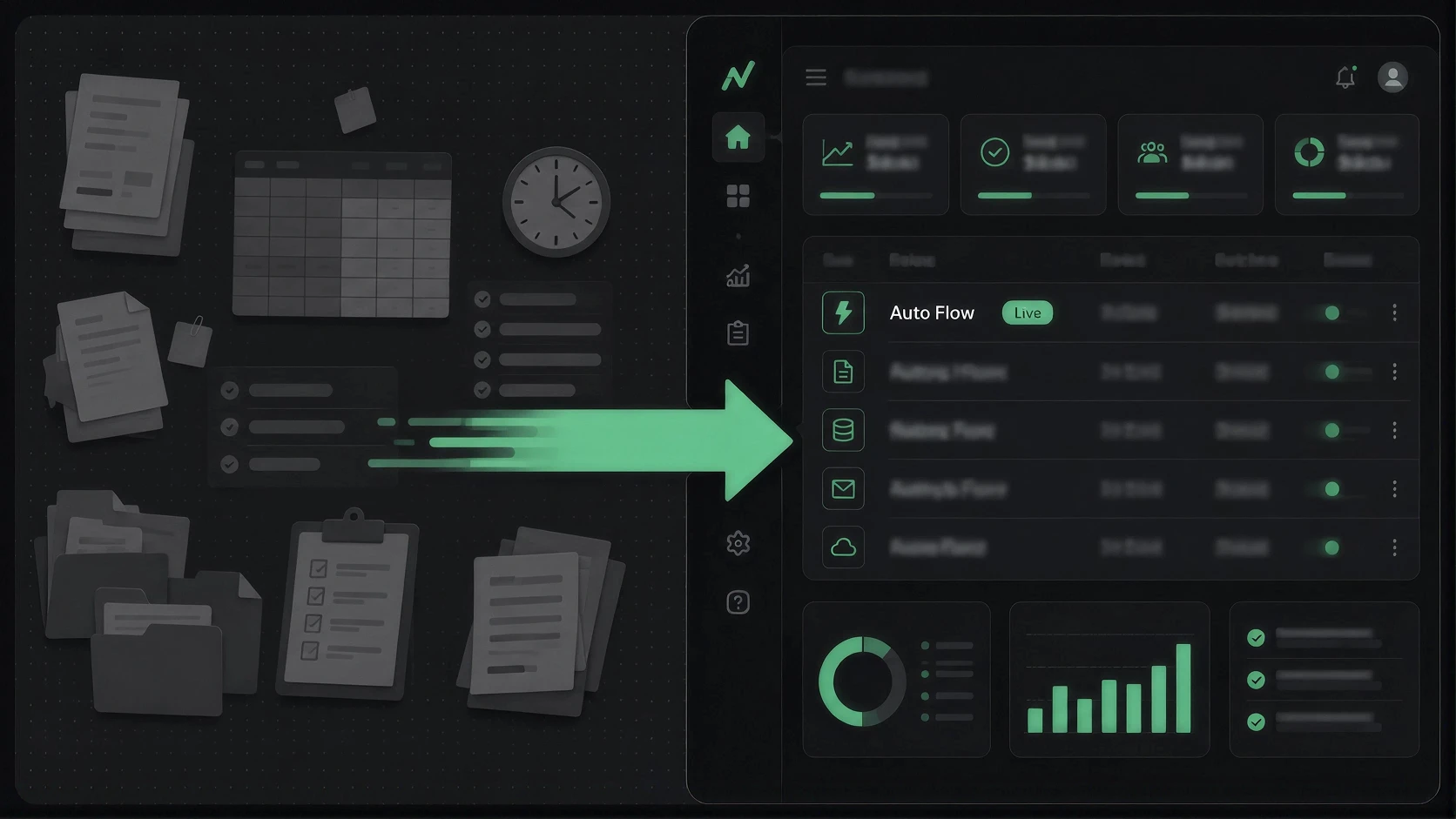
We help businesses replace fragmented workflows, disconnected tools and manual administration with clear digital processes. The result may combine custom software, integrations, automation, AI and UX/UI design — depending on what the operation actually needs.
Process design · System integration · Custom software · Automation · AI
Built with leading
AI technologies
Built with leading
AI technologies



Businesses often accumulate software one problem at a time. Over time, employees bridge the gaps through spreadsheets, email, repeated data entry and undocumented workarounds.
Customer, order and operational information exists in several tools that do not exchange the information the process needs.
Critical workflows depend on files that are difficult to control, audit or scale across a growing team.
Employees copy information, generate the same documents and follow up on routine steps manually.
Managers cannot quickly see the status, owner or bottleneck of a process.
Customers submit the same information several times or wait while internal teams coordinate the next step.
Existing tools support part of the process, while the team creates workarounds for everything else.
Business digitalisation means understanding the complete process, removing unnecessary steps and creating a connected operating model. Technology follows that model rather than defining it.
01
Clarify the steps, decisions, owners and exceptions required to complete the work.
02
Create usable interfaces for employees, customers and partners.
03
Move information between the tools that remain part of the operation.
04
Remove predictable administrative steps while preserving human review where needed.
05
Build the missing software layer when existing products cannot support the required workflow.
06
Make status, ownership, exceptions and performance easier to understand.
Most businesses do not need more software. They need fewer manual handoffs between customers, teams and the tools they already use.


Data entry, email sending and repetitive actions across systems happen automatically.
Requests are processed and routed automatically, without extra manual work.
Your team can handle more customers and higher enquiry volumes without increasing administrative work.
Common areas where digitalisation creates clearer operations and less manual work.
Collect information and documents, validate requirements, request missing details and track progress through one structured journey.
Capture leads from calls, chat, forms and email, qualify them and route the next action into the correct system.
Extract information, validate fields, create records and route exceptions without repeated re-entry.
Coordinate requests, tasks, approvals, status updates and customer communication through one process.
Replace fragmented spreadsheets and manual follow-up with a purpose-built internal tool.
Build portals where users can submit requests, access documents, update information and follow progress.
Bring relevant operational information into dashboards that support decisions rather than create more reporting work.
Make internal procedures and business information easier to access and act on.
A controlled route from current-state friction to a working digital process.
01
We review the business objective, existing process, systems, participants and recurring problems. You get a stakeholder review, current-state understanding and initial opportunity definition.
02
We document the workflow, information, decisions, exceptions and manual handoffs. You get a current-state process map, bottleneck analysis and system and data overview.
03
We define the target process, user experience, architecture and success criteria. You get a target-state workflow, solution concept and prioritised delivery scope.
04
We implement the required interfaces, integrations, automation and controls. You get a working digital system, integrations and workflows, plus testing and documentation.
05
We introduce the solution, train users and monitor how it performs in real work. You get team onboarding, a controlled launch and a performance review.
06
We refine the workflow, resolve weak points and expand the system as the business changes. You get ongoing support, process optimisation and additional capabilities.
Depending on the scope, the engagement may include:
Choose the engagement that matches how clear the solution already is.
Best when the existing process is essentially sound, but some actions are still handled manually.
Best when it is clear which product, portal or internal tool needs to be built.
Best when the main problem is an unclear or inconvenient user experience.
Best when you need to assess and prioritise AI and automation opportunities specifically.
Best when the problem spans several processes, people and systems, and the final solution is not yet clear.
The exact system may include existing software, new interfaces, integrations and automation working together.
Begin with a review, a focused process project or a broader digitalisation roadmap.
01
For a business that knows a process is inefficient but has not yet defined the right solution. Typical outcome: current-state assessment and recommended next step. Price: from €[PLACEHOLDER].
02
For one customer or operational workflow with a defined transformation goal. Typical outcome: designed, built and implemented digital process. Price: custom scope.
03
For several connected workflows, teams or systems requiring phased modernisation. Typical outcome: prioritised programme with staged implementation. Price: custom scope.
04
For businesses that need continuous design, development, automation and system improvement. Typical outcome: long-term delivery and technical support.
For a business that knows a process is inefficient but has not yet defined the right solution.
From
€[PLACEHOLDER]
Current-state assessment and recommended next step.
What's included
Most common starting point
For one customer or operational workflow with a defined transformation goal.
Custom scope
Designed, built and implemented digital process.
What's included
For several connected workflows, teams or systems requiring phased modernisation.
Custom scope
Prioritised programme with staged implementation.
What's included
How to automate repeatable processes across email, documents, CRM, ERP and spreadsheets without replacing the systems that work.
View serviceA practical way to select processes where AI and automation can create the greatest business value.
View serviceA practical comparison of when to choose RPA, when to use AI automation and when a hybrid approach works best.
View serviceIt is enough to show us the problem. We will help assess which solution fits your business best and suggest a realistic first step.
Discuss your business process